build muscle to run better

Running: why build muscle to run better?

Jean-Baptiste Hochart, a running coach, explains the benefits of strength training for improving your running performance.

What if you added strength training to your running routine? Yes, building muscle is a smart way to improve your running performance. With the help of Jean-Baptiste Hochart, a running coach, we explain why and how to incorporate strength training into your training plan.

Becoming a more efficient runner through strength training

Why do we talk about running economy?

Strength training has many benefits for running economy, or efficiency:
- Reduces the risk of injury by 30%*, particularly tendinopathy
- Prevents Achilles tendon injuries
- Increases power
- Improves stride
- Enhances overall posture in the long term

Source: Lauersen's systematic review (2013)

While VO2 max (the maximum volume of oxygen an organism can consume during aerobic exercise) and VMA (maximum aerobic speed) are key factors in determining a runner's level, it was observed that a well-trained runner can reduce their energy cost by following a strength training programme for several months.
Here's why : Stronger support reduces ground contact time and decreases oxygen consumption at a given speed. Efficiency in movement becomes crucial, especially in long-distance events like the 5K, 10K, half marathon or marathon.

Weightlifting and running, how to get started?

No need for heavy weights…

Avoid short and intense efforts that could be counterproductive. Jean-Baptiste, a fitness coach, recommends working with light loads (30 to 50% of your 1RM), but with more repetitions: "If there is a muscle imbalance, the body will adapt and compensate with the tendon, and too much load on a tendon means tendinitis. When starting strength training, it's important to follow the principle of gradual progression and to pay attention to any pain, discomfort or soreness."

Listen to your body

While muscle soreness can be unpleasant, it's simply your body's physiological adaptation to the workload. However, make sure that soreness never lasts more than 72 h. If it does, this indicates that the intensity of the loads and/or the repetition of exercises is excessive.

Allow your body time to adapt to the stress with movements it can tolerate", adds Jean-Baptiste Hochart.

About building muscle: Some runners are hesitant to do strength training for fear of gaining weight. Rest assured, when exercises are properly adapted, this training does not lead to muscle hypertrophy. Your figure will not be affected, and the number on the scale will only change minimally.

When to do strength training for running?

"For athletes who train almost every day, it’s important to have an 'off' training day for running and use it for a strength training or weightlifting session."

If that's not possible, Jean-Baptiste suggests an adaptation: "You can also incorporate strength training into your running session. There are two approaches: some prefer to start with strength training and finish with an easy jogging to boost blood circulation, while others prefer to start with an easy jogging as a warm-up before the strength session. It depends on the individual. Strength training sessions can last 20 to 45 minutes."

The running coach emphasizes a fundamental principle: regularity. "It’s better to do short but regular sessions."

Strength training: how many times a week?

The frequency of strength training depends on the number of running sessions. For athletes who run more than 5 times a week, Jean-Baptiste recommends 2 to 3 strength training sessions per week. For those who run 1 to 3 times a week: 1 strength training session is sufficient.

If your running sessions take up most of your time, prioritize strengthening your upper body and core with exercises like planks and push-ups, rather than focusing on the lower body. The lower body is already heavily engaged during running and running drills.

Equipment and facilities required

If possible, work with a fitness coach—it's often more accessible than you might think. A professional coach can provide the best guidance for both leg and upper body workouts, tailored to your needs, mood and any current aches or pains.

Which exercises to do for GPP (general physical preparation)?

How to maintain a good running stride for as long as possible?

To reduce the risk of injury, it's essential to stimulate multiple muscle groups. Key areas for improving your running include: hamstrings, abdominal muscles, upper body, glutes and back muscles. Focusing on these muscle groups helps improve your overall posture and balance, allowing you to maintain an effective stride for longer periods.

Strength training exercises to do at home or in the gym

1- Lunges

Starting Position: Stand with your feet hip-width apart. Step your right leg forward, maintaining the distance. Lift the heel of your back leg.
Execution instructions: Bend both legs simultaneously to 90 degrees. Keep your back straight. Ensure your knees align with your hips. The knee of the front leg should not go past the ankle.
Inhale as you lower, exhale as you rise.
Repetitions: Perform 5 sets of 15 repetitions on the right, then on the left.

Increase the difficulty by holding a dumbbell in each hand.

2- Squats

Starting Position: Stand with your feet slightly wider than hip-width apart, feet parallel. Place your arms horizontally in front of you.
Execution instructions: Bend both legs as if sitting down on a chair. Keep your back straight and engage your abdominal muscles. Ensure your knees stay aligned with your feet and don’t cave inward.
Inhale as you lower, exhale as you rise.
Number of Repetitions: Perform 5 sets of 20 reps

Increase the difficulty by doing back squats (start by carrying an empty barbell).

3- Plank

Starting Position: Lie face down, supporting yourself on your elbows and toes. Your elbows should be shoulder-width apart and aligned with your shoulders. Your knees should be hip-width apart.
Execution instructions: Raise your hips, supporting yourself on your elbows and feet. Your body should form a straight line. Keep your hips neutral (neither arched nor tucked) and engage your deep abdominal muscles (transverse, obliques).
Number of Repetitions: Hold the position for 30 to 45 seconds and repeat 3 times.
Increase the difficulty by adding instability (e.g. doing the plank on a Swiss ball) or adding movement (e.g. lifting your right foot, then your left foot).

4- Push-ups

Starting Position: Get on all fours, with your hands aligned with your shoulders, placed wider than your mat, and fingers pointing forward. From your knees or with legs extended, position yourself in a plank.
Execution instructions: Bend both arms simultaneously, bringing your chest close to the floor. Keep your abs tight and your hips neutral. Avoid doing this movement in two steps (chest then hips); the whole body should move up and down as one unit.
Number of Repetitions: Perform 5 sets of 10 reps.
Increase the difficulty by doing push-ups with your hands closer together.

5- Dynamic Plank

Starting Position: Face down, place your hands shoulder-width apart and your feet hip-width apart.
Execution instructions: Bring your knees to your chest.
Number of Repetitions: 4 sets of 20 secs max.

You can combine the exercises mentioned above into a HIIT routine. This practice, often done with bodyweight exercises, combines cardiovascular effort with strength training, making it ideal for when you have less than 30 minutes. It's also beneficial to engage in more targeted training using weight machines.

Strength training at the gym

Ensure you warm up (by running on a treadmill or cycling on a stationary bike for 20 to 30 minutes, for example) and start your session with light weights or an empty barbell to reduce the risk of muscle or tendon injuries.

Which machines or stations to use?

Jean-Baptiste explains that the incline leg press can be a useful tool for beginners because it is a guided exercise. Pay close attention to your sensations. The coach recommends performing 4 sets of 6 to 12 reps per exercise, adjusting according to how you feel over the course of your sessions. Perform the first set without any weights.

1-  Deadlift
This compound exercise promotes overall body stability. It targets the posterior chain: back, glutes and hamstrings.
Starting Position: Feet flat, parallel, and hip-width apart, with knees slightly bent and thighs engaged. Position your shoulders over the bar with arms shoulder-width apart. Your hands should be in a pronated grip on the bar, positioned at the level of your shins. Keep your shoulder blades fixed along your back, chest open, abs tight, back straight, and gaze forward.
Execution instructions: Remember to breathe during the deadlift: exhale as you lift and inhale as you lower.

2 - Lat Pulldown

This exercise develops the dorsal muscles necessary for pelvic stability.
Starting Position: Sit on the lat pulldown bench with your chest upright, slightly inclined backward at a maximum of 15 degrees. Grab the pulldown bar with either a supinated or pronated grip, as preferred. Inhale and contract your abs, arms, and back while keeping your shoulders down.
Execution instructions: Pull the bar towards your chest while exhaling. Your arms should form a 90-degree angle alongside your torso. Ensure your shoulders do not rise at the end of the movement. Slowly return to the starting position, maintaining a slight bend in your arms at the end of the movement.

3- Calf Raises

Starting Position: Stand with the balls of your feet on a step, leaving your heels hanging off the edge. Hold a guided weight on your shoulders.
Execution instructions for calf raises: Raise your heels to stand on your tiptoes, then lower your heels below the step line, controlling the descent.

💡 Coach's tip: Focus on the eccentric phase (the descent), performing it over three counts. The ascent should be more dynamic, taking one count.

ℹ Don't hesitate to seek advice from a running coach or sports specialist before incorporating new strength training exercises into your regular routine. Always aim for gradual progression, consistency, and give proper attention to recovery time as it is an integral part of your training!

Why not try plyometrics?

Plyometrics is another effective way to strengthen your body and can be highly beneficial.

1-  Step Squats
To strengthen the thighs: Stand on a step. Drop forward into a half-squat position upon landing. Control and stabilize your landing. Your hips should be level with your knees (do not lower your hips all the way to the ground) and hold the position for a few seconds upon landing.
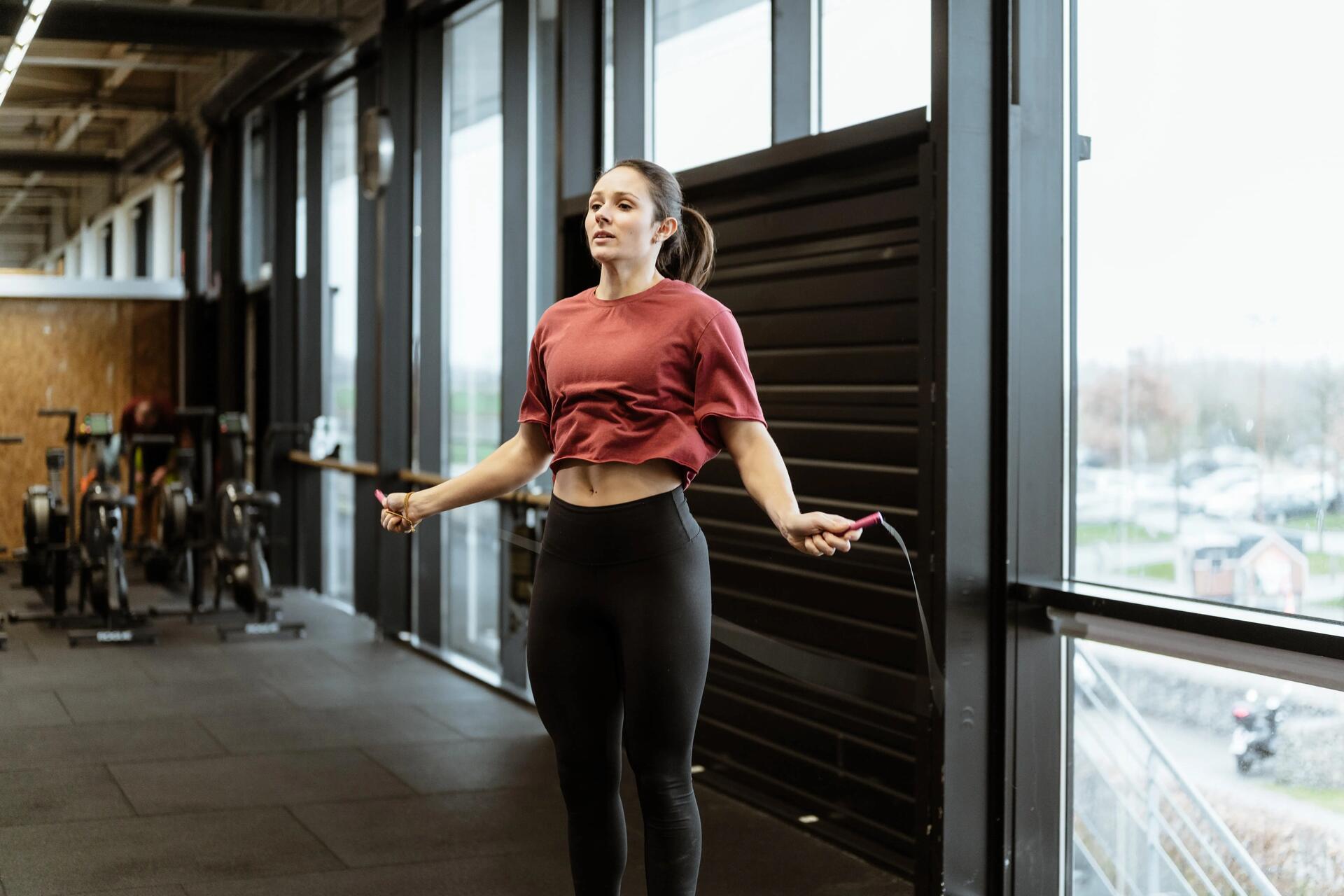
2- Jump Rope
To strengthen the calves: Use a jump rope or perform small jumps in place if you don’t have one.
To increase the difficulty of the exercise: try jumping on one foot!

Specific knee-strengthening exercises

For runners, you don’t need to have knee issues to benefit from targeted strength training. Strengthening the muscles around the knee joint enhances stability and reduces the risk of discomfort or injuries that could slow down your progress. 

Jean-Baptiste recommends half squats and lunges as essential knee-strengthening exercises for running. Once these exercises are mastered, he suggests progressing to Bulgarian split squats, which focus on single-leg strength, and the pistol squat, where you sit on a bench with one leg while keeping the other extended (note that this exercise can be quite challenging, so proceed with caution).

These exercises engage the entire thigh, particularly the muscles that support the knee joint. Don’t skip them! Perform 3 to 4 sets of 8 reps for each exercise, always adhering to the principles of gradual progression, consistency and listening to your body.;)

Cross-training to improve your running:

Cross-training—which consists of incorporating a different sport into your routine alongside your main activity—offers both physical and mental benefits and helps make you a well-rounded athlete. Continue to engage your cardiovascular system and strengthen your body while experiencing new sensations. This approach can be particularly motivating, especially when the weather discourages you from going outside…

So, are you ready to add strength training to your sports routine?
Thank you, Jean-Baptiste, for all these valuable tips on improving running performance!

Céciliane

Journalist and sports coach

Always ready to experience major sports events and share the excitement of sports!