How to choose your swimming equipment our guide

How to choose your swimming equipment ? 

Where should you start to find the right swimming kit? Swimsuit, cap, goggles, fins, towel—let’s take a look at the essentials together.

Ready to get into a new swimming routine? We’ll help you make sure you don’t forget anything with this list of essentials to put in your bag—so you can swim more, swim better and stay motivated!

What equipment do you need for swimming?

Get the most out of your swimming sessions with the right equipment! Shall we give you a quick rundown of what you need to be at the top of your game?

  1. A swimsuit (naturally) specially designed for swimming
  2. Swimming goggles
  3. A swim cap (yes, we know you’re not a big fan of that one)
  4. Specific equipment if you want to work on your technique or increase the intensity: fins, pull buoy, centre snorkel, hand paddles, kickboard...
  5. Accessories to make your life easier both in and out of the water!

Choosing your women’s swimsuit

How to choose buyer’s guide to swimsuits.

Your choice will depend on your ability and, above all, how often you train, because your needs will evolve accordingly!

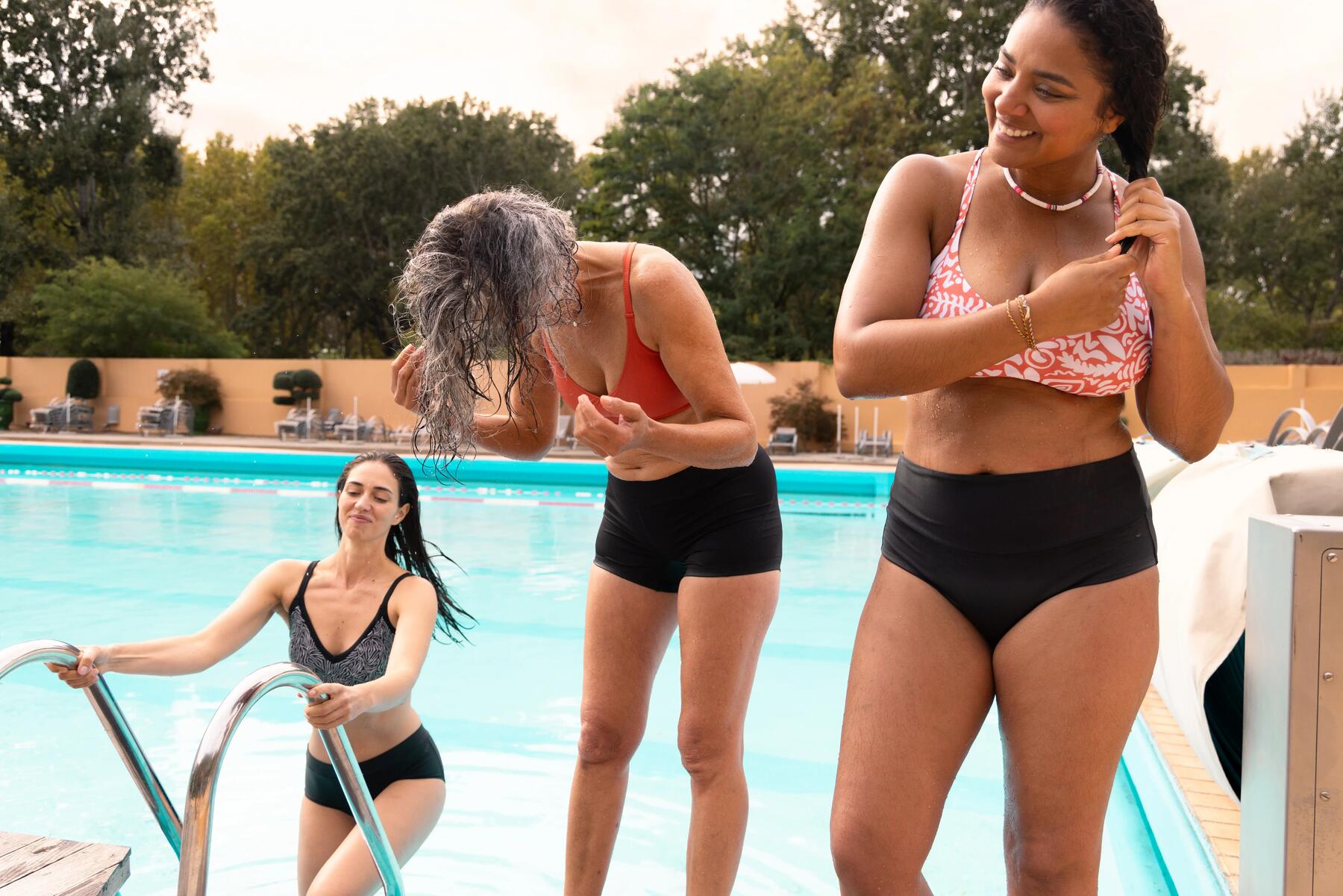
One-piece or two-piece swimsuit? Ladies, you decide! Above all, it’s a question of personal preference and comfort. A one-piece swimsuit is a classic and very versatile. It offers great freedom of movement and a secure fit. A two-piece swimsuit can be very practical, especially if you need different sizes for your top and bottom, or if you like to mix and match.

Are you new to swimming or do you swim occasionally? In this case, your priority is 100% comfort. The aim: to find a swimsuit in which you feel completely comfortable. Don’t want to have to wrestle your swimsuit on and off, especially when it’s wet? Go for U-shaped straps, they’re the easiest way to go. For extra support, especially if you’re doing water-based activities such as aquafitness, choose a swimsuit with a built-in bra and wide straps for additional bust support.

Is the pool your second home and you’re on a quest for performance? At this level, it’s a good idea to look for more technical swimwear, particularly in terms of hydrodynamics. You’ll need an excellent fit and impeccable stability if you want to be at one with the water (or, more importantly, if you don’t want to have to readjust your swimsuit with every length). Freedom of movement is also a key factor in allowing you to concentrate on your swimming technique. For this, opt for narrow straps and X-, Y- or O-shaped backs. Expect a high-cut leg, as these are more technical swimsuits designed for training.
What is the best swimwear for men?

To find the model that suits you best, pay attention to the shape of the swimsuit and what it’s made of.

  • Swim briefs: Short on the thighs, they offer excellent freedom of movement and reduce chafing in the water. It’s a shape built for performance.
  • Boxer swimming shorts: Offering slightly more coverage than briefs, they stop at the top of the thighs. It’s a good balance of freedom of movement and a little more coverage.
  • Jammer: This swimsuit goes down to just above the knee. Excellent hydrodynamics, helping to reduce drag and improve your glide. It also provides good muscle compression.
  • Swimming shorts: Generally looser and longer, they are perfect for relaxation and leisure time. However, they are not ideal for intensive training, as they create more resistance in the water (and they are banned in many municipal swimming pools in France, so be sure to check the rules before putting them on).

Chlorine resistance: an essential criterion!

Last (but not least) criterion when choosing your swimsuit? Its chlorine resistance! The calculation is quite simple: the more time you spend in chlorinated water, the greater your need for a swimsuit with high chlorine resistance. Because once you’ve found a swimsuit you feel comfortable in, you don’t really want to have to replace it because it’s getting loose or faded!

Choose swimming goggles

How to choose your swimming goggles

To make the right choice from among all the options, we’ll look at three key points: your swimming ability, where you swim (i.e. the light conditions) and the size of your goggles.

Let’s start with your ability:

If you’re new to swimming, your priority is comfort, simplicity and a wide field of vision. Swimming masks can be an excellent option. When it comes to adjustment, keep it simple: easy-to-adjust straps, a practical buckle at the back and a fixed or notched nose bridge.

If you have a good skill level and are used to being in the water, you’re probably looking for a fairly wide field of vision and good stability. These goggles have a more flexible nose bridge or interchangeable nose bridges. The strap adjustment is simple but effective.

If you’re an advanced swimmer, then hydrodynamics and stability take priority, so that your goggles don’t move a muscle during dives and tumble turns! You’ll find models with removable nose bridges for a made-to-measure fit, or even the classic "Swedish" goggles that you have to assemble yourself for a perfect fit.

The colour of the lenses depends on where you swim:

  • Category 0: Clear lenses, for low light levels.
  • Category 1: Light lenses are ideal if you swim in a medium-light environment.
  • Categories 2 and 3: Smoked lenses, perfect for brightly lit environments.

How to choose the size of your goggles

Broadly speaking, there are 3 types of swimming goggles

  • Kids’ goggles
  • 2 sizes: Size S (suitable for both children and adults) and Size L (mainly for adults but may be suitable for some children)
  • One-size models
A simple test: dry, without using the elastic band, place the lenses over your eyes and press lightly. If the goggles have a "suction cup" effect and hold, they’re the right size. If not, try a different pair. Once you’ve found the right size, adjust them with the straps and nose bridge—not so tight that you risk injury, but tight enough to prevent any water from seeping in.

Friendly advice: the best thing is to try on swimming goggles before you buy them. That’s the secret to perfect comfort!
Some more friendly advice on how you can look after your swimming goggles
  • Rinse your goggles in fresh water after each use.
  • Do not touch the inside of the lenses to avoid removing the anti-fog treatment
  • Store them in a case or pouch to avoid scratches

Ah, the swimming cap... We know it’s not necessarily your favourite piece of equipment, but it really is essential! Why? Firstly, out of respect for the place where you swim: it helps to keep the water clean and the equipment in good condition; it’s a question of pool hygiene. Secondly, you’re also wearing it for yourself! It protects your hair from chlorine, salt and anything else that might be in the water.

To choose yours, the material will be the main criterion, followed by the type of discipline, the size and, of course, the style! Bear one important thing in mind: not all swimming caps are 100% waterproof! The more water you want to keep out, the more difficult it will be to put on!

A fabric or mesh cap is very stretchy and ultra-practical, as it is easy to get on and off without pulling your hair. The minor "downside": it lets more water through.

A silicone cap offers excellent stretch and a very secure fit. It’s the king of keeping water ingress to a minimum. However, it can be a little less pleasant to get on and off because it sometimes pulls hair.

A silicone mesh cap is the happy medium between fabric and silicone! The inside is made of fabric for easy fitting (without pulling hair) and the outside is coated with silicone to reduce water entry and provide greater stability. It’s a good compromise, although like any compromise, it will be less stretchy than pure fabric and less watertight than pure silicone.

Swimming equipment

Fins, pull buoy, hand paddles, snorkel, kickboard, swim tether... There’s a whole host of equipment out there to help you perfect your stroke or work on specific parts of your body during training. Shall we give you a quick recap?

Your choice will be based on two main criteria: your skill level and what you specifically want to work on. Basically, you need to consider: your shoe size, the length of the fins, their stiffness , the type of foot pocket.

Choosing your swimming fins according to your ability: what does this mean in practical terms? Well, if you’re just starting out, you’re going to need equipment that’s flexible and comfortable, so forget rigid fins that are likely to put you off after a few lengths. As you improve, you’ll be able to move onto fins that optimise propulsion and increase muscle strengthening.

So, in terms of length, what are we talking? A short blade gives you a higher, more natural kicking frequency, whereas long fins allow you to concentrate more on strengthening your legs and glutes. They generate more resistance and a better feeling of glide and speed.

Rigid, semi-rigid or flexible fins: how to make the right choice? Rigid fins require significant muscular and cardio effort due to their density. They are best suited to swimmers of a certain level. They should also be avoided in the event of injury or rehabilitation. Semi-rigid fins are an excellent compromise for working on cardio and muscle strength with moderate effort and a good range of motion. Flexible fins, on the other hand, offer a movement close to your natural stroke, with gentler muscular effort. We recommend them if you’re just starting out or if you’re looking for a less intense workout.

How to choose your swimming hand paddles

How to choose your pull buoy and your hand paddles

Shall we start with the pull buoy? It goes between your thighs or calves. Its role? To immobilise your legs and make your lower body float. With it, you can fully concentrate on working your arms and torso. Combining it with hand paddles increases the muscle work of the upper body: And if you want your legs to be completely immobile, feel free to add an ankle band, however this is much more demanding in terms of core strength.

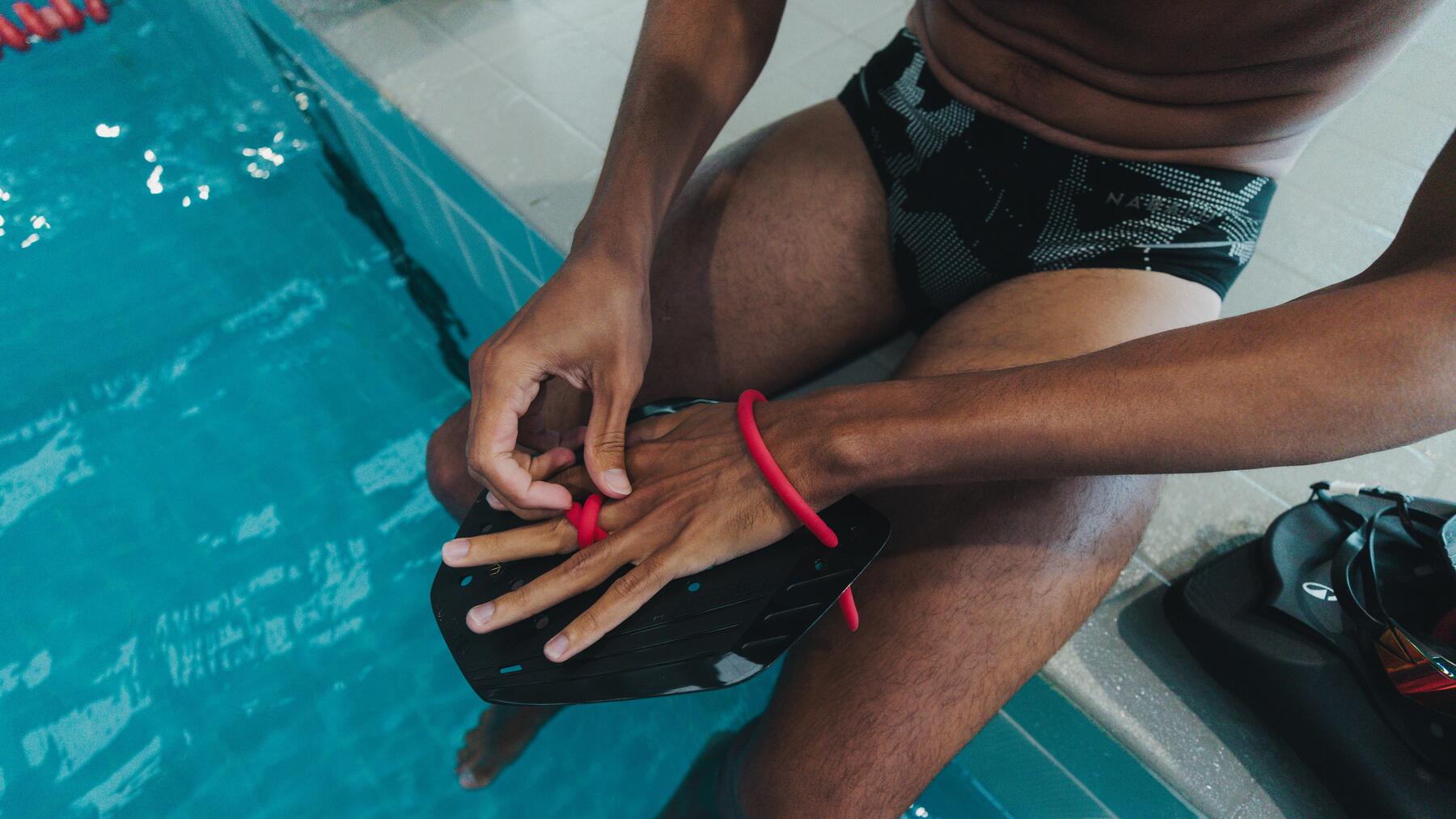
Hand paddles can be used on their own or in conjunction with a pull buoy. They can help you to improve your technique and increase your power. They are worn on the hands or fingers to increase your thrust and give you better catch in the water. They are mainly used to work the upper body (arms, shoulders, pectorals, back).

This equipment is chosen according to your ability and your desired intensity. To start with, opt for small hand paddles. If you are a strong swimmer but are fairly new to hand paddles, start with size S and increase the surface area as you become more comfortable. Are you at an advanced level? In that case, you can try size M or L hand paddles for more power and propulsion. "Finger" paddles are also good for breaststroke and butterfly.

Centre-mounted snorkel a piece of equipment to perfect your technique

If you want to improve your swimming stroke and concentrate on your technique by eliminating the restrictions of breathing... Here’s what you need: the centred-mounted snorkel. With it, you no longer have to think about breathing, leaving you free to focus on your arm movements and body positioning. Combined with a pull buoy, you can even work exclusively on your arms, concentrating 100% on your technique.

They come in sizes S/M and M/L to suit all face shapes.

Have you considered a kickboard?

Thanks to its buoyancy, a kickboard is perfect for strengthening your lower body muscles (calves, thighs and glutes). With it, you can vary your workouts and focus solely on your kick. The lower the kickboard’s buoyancy, the greater the muscular effort required.

Accessories to make life easier

In addition to the technical equipment, there are all those little extras that make your swimming sessions even more enjoyable. We’re thinking, for example, of how you carry all your kit: your swim bag. Ideally, it should be well ventilated and, if possible, have separate compartments for your wet and dry items. Your current sports bag doesn’t have this type of pocket? Get yourself a waterproof pouch!

And the towel? Cotton for softness, microfibre for quick drying and compact size—it’s up to you to decide which one to wrap yourself in.

Your feet also have the right to be equipped. Pool flip-flops or sandals are more than just a question of style or comfort, they are above all a matter of safety and hygiene. Choose non-slip, comfortable ones, and you’ll be all set to hit the pool.

Now you know what you need in your bag and you’re all set for your next few sessions, all you have to do is find a time to go swimming!