how-to-choose-your-hiking-trekking-boots

How to choose your hiking or trekk?

Your boots are a key element of your hiking or trekking gear. Follow our complete guide for proper foot attire!

Choosing the best hiking boots is guided by several criteria: the terrain, duration of the excursion, weight of your backpack, and the weather. We help you to find the ideal boot, so that your adventure unfolds with comfort and peace of mind.

1. The expected terrain is:

If there is one question you should ask yourself before choosing your footwear, it's “what type of hiking am I going to do?”.
That is to say, on what type of terrain? For how long? And what about the weight of your backpack? 

In terms of the terrain, there is a wide range of hiking boot models designed specifically for the terrain you’re going to be covering.
If you’re walking on lowlands you won’t have the same needs as you would for mountain walking.
Each type of terrain has its own specific features.

On lowlands, in the forest or on the coast, with a little elevation:

If you’re planning a short day-hike in the lowlands, forest, or along the coast, choose hiking boots from our "nature" range 

These boots typically feature dual-density soles: a first layer close to your foot provides cushioning for comfort, while a second layer closer to the ground offers shock absorption from rocks. 

Their lugs and outsole provide excellent grip on varied types of terrain, such as forest trails or coastal paths. On the other hand, avoid technical passages or too high a gradient.
With less rigidity than mountain hiking boots, they provide maximum comfort and cushioning so that you don't feel the roughness of the trails.

In the mountains, on steep trails:

Are you looking to reach mountain summits via more technical paths, with more climb? 

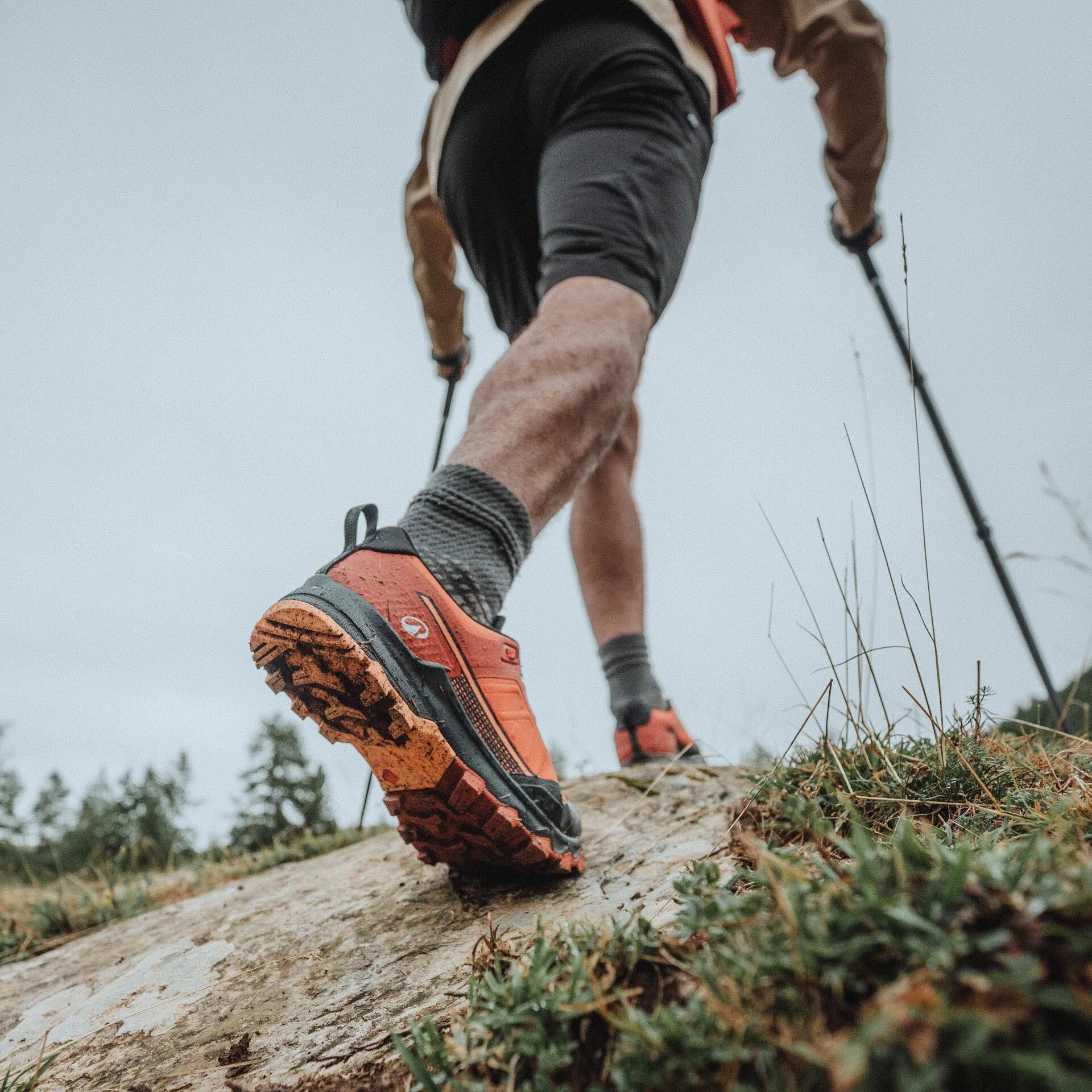
If you most often practise mountain hiking and you’re going to be on rocky terrain or pass through technical sections, it’s preferable to opt for hiking boots specifically designed for mountain use. 

They’re lighter so that you’re less weighed down during climbs.
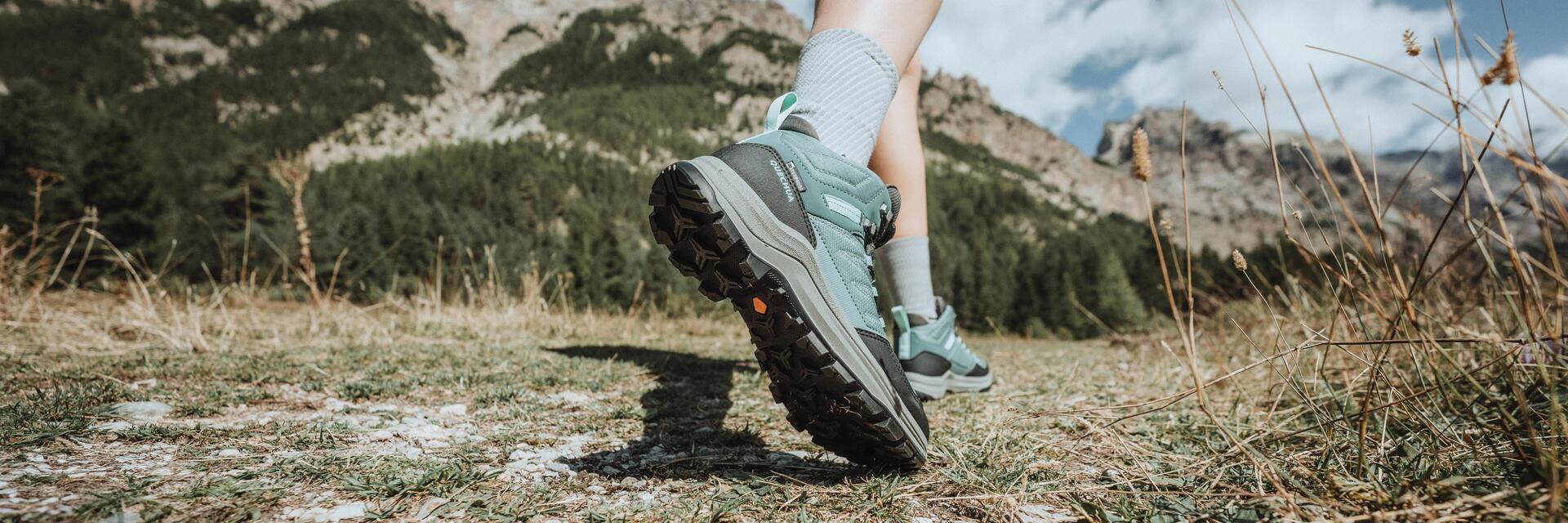
Their sole and crampons also have good grip and traction so you don’t skid on steep trails or in scree.

These are the two main promises made by the CONTACT technology integrated into our hiking boots at Quechua.
Often the front of the boot is also reinforced with a toe bumper to protect your toes (similar to safety shoes).

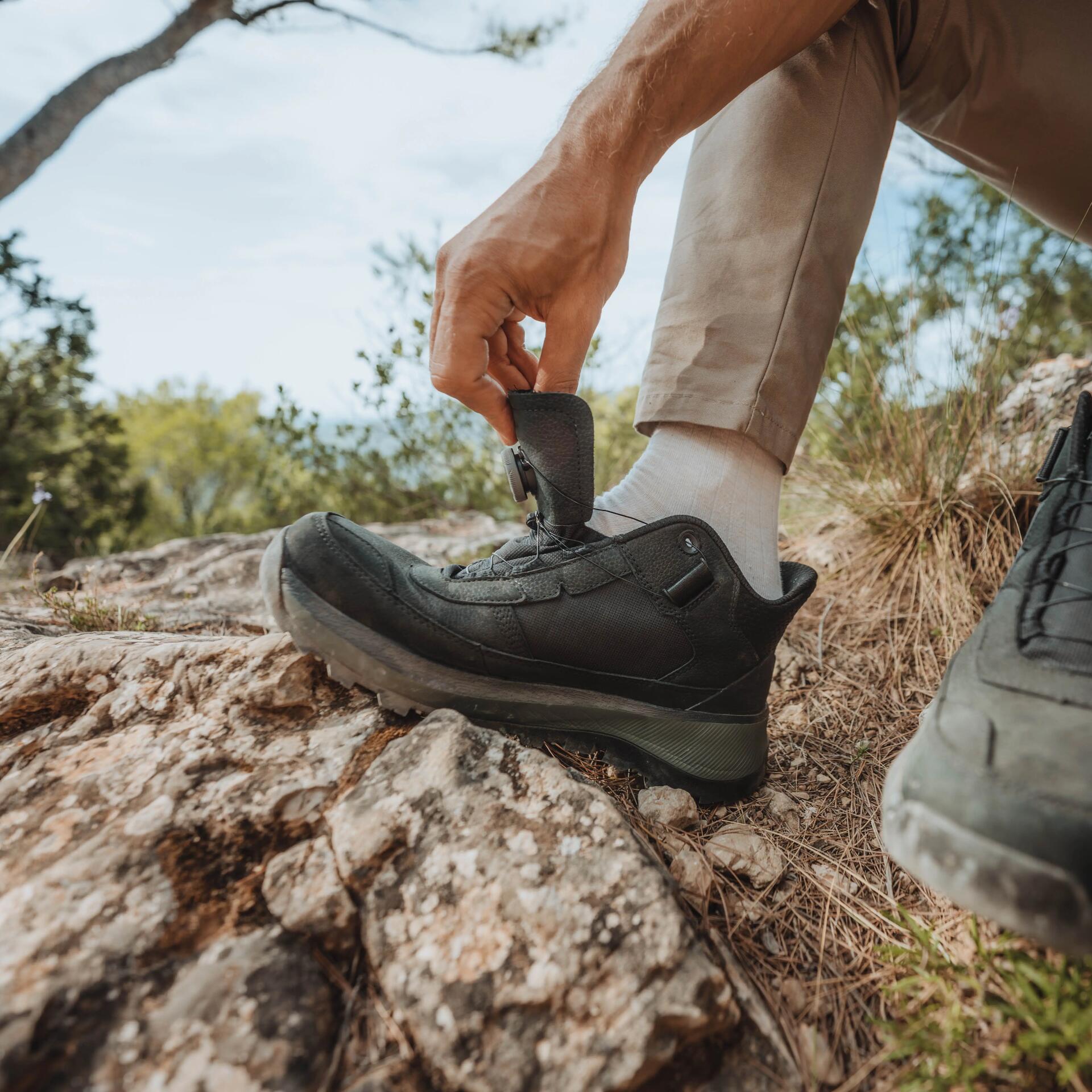
Usually, these hiking boots offer more rigidity, have precise lacing and a foot support designed to keep you comfortable on all types of terrain. 

They also have better ankle protection thanks to their high-rise upper - not an insignificant feature when you find yourself on the technical sections you often come across in the mountains.

On snowy trails:

Are you looking to tackle snowy trails and peaks?
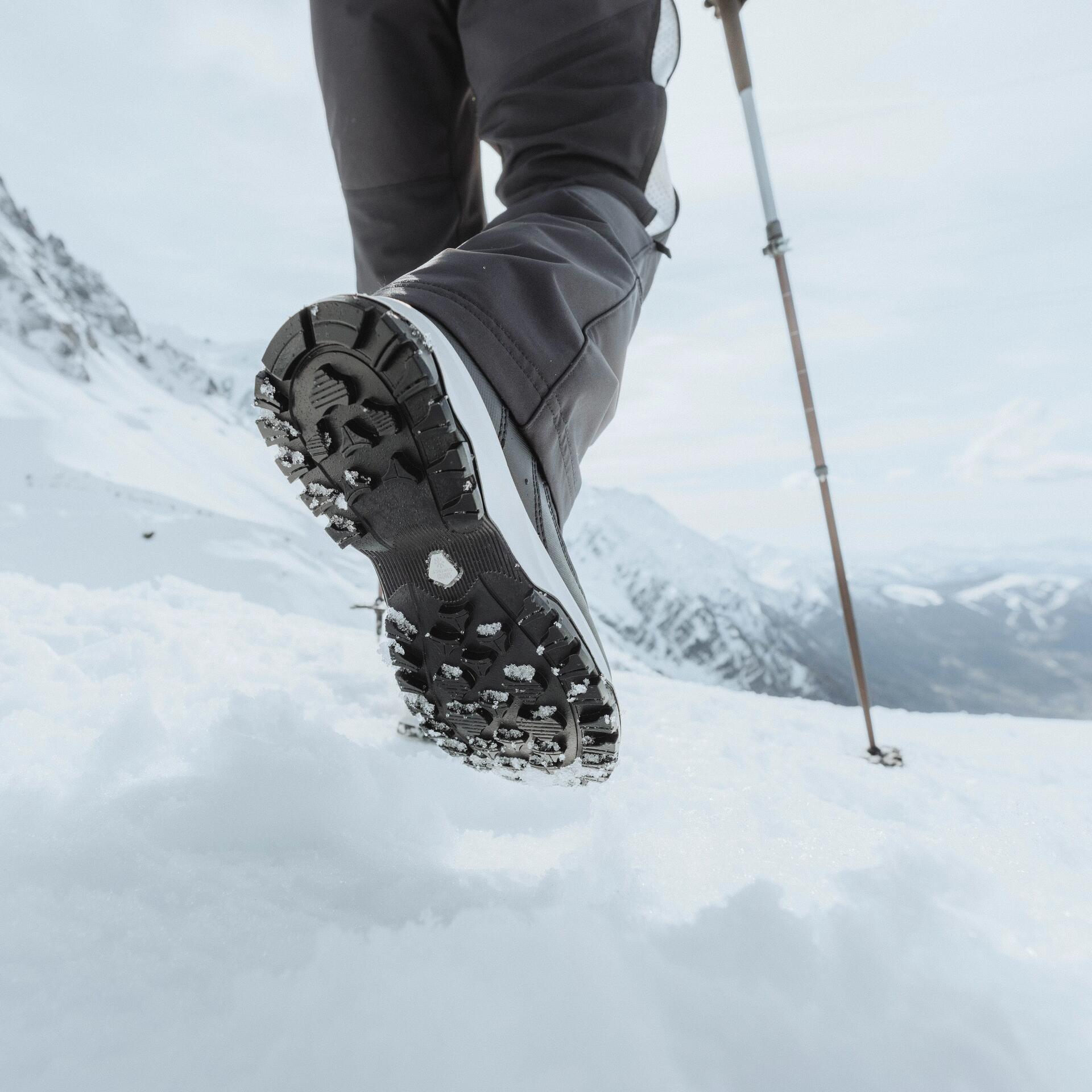
In this case, your choice is everything!In fact, where there’s snow involved, this calls for warm, waterproof boots. 

We recommend you choose snow hiking boots that insulate you not only from the cold, but also the moisture of the snow.
Snow hiking boots are equipped with waterproof, breathable membranes so they don’t turn into a sauna for your feet, which would then be drenched in their own perspiration (it goes without saying that a sauna would be better "after the hike," not during!).Their soles also insulate and the boots have an anti-ingress system preventing the snow lifted by one boot from falling back into the other.

Some of our snow hiking boots are equipped with CONTACT technology,the result of lengthy tests. CONTACT outsoles are made with a special material and lug pattern specially designed to ensure the best possible grip and traction. This makes them more effective on snow than standard soles.

Paired with a pair of snow hiking socks, and by choosing a suitable size that leaves a bit of space for your toes, your boots will go along with you wherever you go, so you don’t have to worry about the cold or the snow!
The insole is to the boot a bit like the mattress topper is to the mattress.
People think that they don’t need them and that if they have chosen their boots well, they can do without them. 

This is absolutely true!

However, your foot may change over time, or the weather may not always be kind to you.
You can then have a gel insole for maximum cushioning in summer, and opt for a felt insole with "fleece"for extra warmth, or a leather insole that will mould to your foot perfectly over time.

2/ Walking time

If the type of terrain influences your choice of boot, so should the duration of your hike.
To reiterate, you won’t have the same needs if you’re setting off for a half-day or for several days. Is your excursion going to last from a few days to several weeks? 

Are you planning to set off to explore new trails over a week of trekking? 

If the answer is yes, then you’ll need sturdy and durable shoes that won’t let you down during your entire trip - and even more so if you are going mountain hiking for a few days and you can’t take several pairs of boots along with you. 

In this case, opt for trekking boots. Their durability will get you through kilometres day after day on all types of terrain. Their high upper also properly supports your ankle giving greater comfort for the duration.
If instead you plan on hiking for a half-day or full day, your selection criteria will be different.
In fact, although a trekking boot is more durable, it can also be heavier than a standard hiking boot.
For day hiking, go for hiking shoes instead of trekking.

3/ Your backpack weight

Another factor to take into account when choosing your hiking or trekking footwear: your backpack weight.
Who would think of trying on a pair of shoes in store with 10 kg on their back? Surely not many people. 

However, your backpack weight will heavily influence your choice of footwear.

If you're not carrying a backpack, or it is light because you’re planning a short outing, then you can choose soft and lightweight shoes, if the terrain allows. On the other hand, if you are carrying a heavy backpack with your trekking material for a few days then you should choose another type of footwear. In this instance, you would be wise to choose a high upper boot for greater support, and more rigid for greater stability.

4/ Support and fit

Is it better to have high or low hiking shoes?

There are two other factors to take into account: the fit and the size. 

If you’re going to be hiking on uneven or steep paths, a high upper will be useful for good ankle support.
This also prevents the ingress of stones and dust in the boot for example. 

What’s more, if you’ve been following closely, you’ll already know that the weight of your backpack may influence the choice of height for your boot’s upper. the heavier your backpack, the more support you will need for your ankles with a high upper.
If you are looking for lightness and freedom of movement for your ankle, choose a low upper.

What size hiking boots?

We often hear that you should go up a size for hiking boots... but not necessarily! In fact, it’s different for everyone. Our feet do not all "swell" in the same way after physical exertion, some people have a difference of half a size between their right and left foot, etc. 

I’m sorry I can’t give you a universal solution to this question... 
The best option is to try your hiking boots at the end of the day, with hiking socks.

What differences are there between men's and women's hiking boots?

Some brands of hiking boots take into account average differences between men’s and women’s feet. 

This doesn’t mean that these averages are absolute morphological realities, nor does it mean that they necessarily fit you as an individual.
For example, the width of the foot is sometimes wider in the men’s range. 

In addition, sizes often start at UK size 6.5 in the men’s range. Again, try on what you like and trust your feelings: 
 your foot will tell you if it’s comfortable or not. 

So, if you prefer a man’s design when you’re a woman (or vice versa), and you find your size and it feels good - then go for it!

5/ Weather

For the final steer in your choice, here is one last criteria to consider: the weather.

On dry ground or with a little morning dew, waterproof shoes aren't required. A water-repellent shoe will do the job. The drops of water slide off the fabric and your feet stay reassuringly dry.

On soaked ground, during a rainy hike or feet in 40 centimetres of fresh snow, don't even ask yourself the question: choose a waterproof boot that will insulate you from moisture. 

Laboratory tests help to assess a boot’s waterproofing capacity. During these tests, the shoes are half immersed in water and 3 levels of waterproofing are tested: 2,000 flexes (approx. 4 km walk), 4,000 flexes (approx. 8 km walk) and 8,000 flexes (approx. 16 km walk). 

These different levels of waterproofing are advertised in the boot features.

Lightweight and breathable summer shoes in warm and dry weather

Do you generally hike in high summer when it's very hot? Breathable hiking shoes are the answer! These models have greater breathability thanks to the mesh used and they stop you perspiring when hiking. There’s nothing more uncomfortable than hiking with a damp foot that sometimes slides around in your boot! 

If you want complete foot ventilation, rather opt for sandals. Their sole and toe bumper, at the front of the shoe, protect the foot and give the same grip as a boot.

The final small word: to avoid blisters, stay warm (or cool) and protect yourself from insects in the tall grass, don't neglect your choice of hiking socks!

Now you're fully kitted out, the trails await!

Maguy

Quechua hiking enthusiast

We also recommend our other hiking advice

comment_choisir_chaussettes_randonnEe_conseils

How to choose hiking socks?

Check our tips to help you choose your hiking socks.

How to choose warm or après-ski shoes - Title

How to choose warm or après-ski boots?

Check out our advice to help you select your warm or après-ski boots. As we know, when it's cold, it's the extremities that let us know. It’s important to wear the right footwear to stay warm and dry.