bike lock - how to lock up your bike

Which bike lock is best for your bike?

A good lock is your bike's best defence against theft. D-lock, chain or cable? Follow our guide to choose the right protection and keep your bike safe.

D-locks, chains, cables or folding locks: the market is full of options. While D-locks are top-tier for security, other models offer practical benefits like compactness or ease of use. Discover which one suits your daily rides best.

Tips to avoid overexposure to theft

Before going into detail about the range of different types of bike lock and choosing the best possible protection for your bike, here are two tips designed to reduce the risk of theft, over and above your bike lock equipment:

- Always attach your bike to a fixed support that is well anchored to the ground and very solid. Some thieves choose to break/cut the support rather than the bike lock when the latter is a strong deterrent and the support is not strong enough. Attaching only one of the wheels to the frame, without securing the whole assembly to a solid point, is not enough; worse still, it can attract the attention of thieves.
- Attach your bike in a well-lit, public place so that it is as exposed to view as possible.

Where should you place your bike lock?

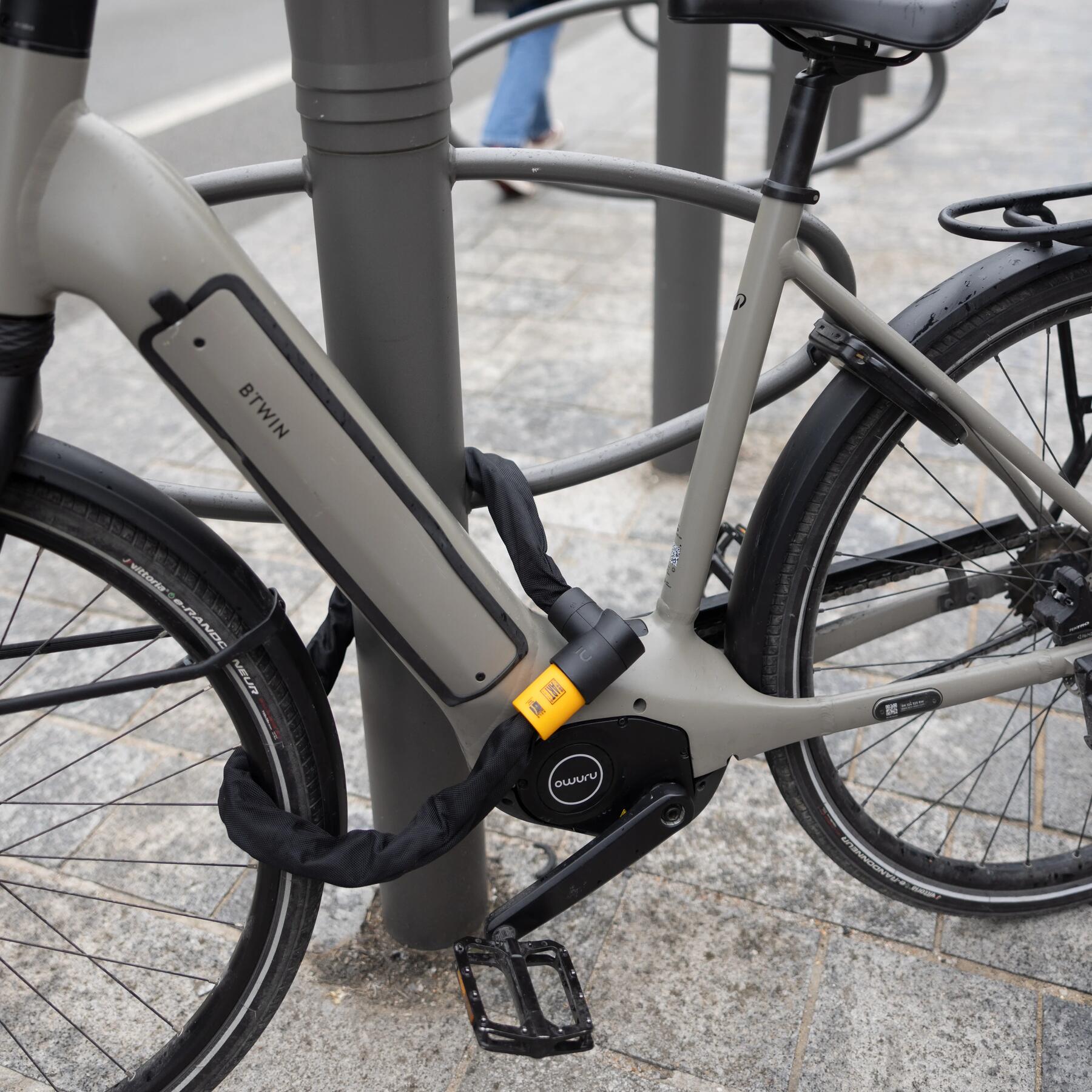
Ideally, you should protect the front wheel, rear wheel, frame and saddle. These 4 elements should therefore be secured to provide optimum protection against theft. Securing several parts of the bike with different bike locks will force thieves to use different tools, too, and so slow down their progress.

Which is the most effective bike lock?

As you can see, the key to preventing bike theft is to use a combination of at least 2 bike locks. To help you choose, you need to know a little about the different bike lock models. Here are the advantages and disadvantages of each model that could potentially come to your rescue.

Comparing bike locks

D-lock, the best bike lock available

D-locks are the most resistant, and can also be compact, relatively light and very good value for money. If you're looking to minimise the risk of theft, they're the best choice. Thieves fear them, cyclists treasure them.

The case-hardened or tempered steel bar, bent into a U-shape, is very strong and particularly suitable for those who use their bikes on a daily basis, with long exposure times to theft. So if your bike is expensive, don't hesitate to use two D-locks to make it as secure as possible. One large D-lock, which secures the frame and rear wheel to a solid support anchored to the ground. Another, smaller, D-lock secures the front wheel to an immovable support.

Large and small D-locks offer the same level of security. Their weight differs quite significantly, depending on their size. If you want to secure the front wheel as well and you only have one D-lock, get a cable that you can pass through the spokes of the front wheel and loop through the D-lock that already secures the frame and rear wheel.

D-locks can be carried in a rucksack, pannier, basket or directly on the bike frame using a special bracket. Sometimes they can even be found attached to cyclists' belts - practical and stylish!

The chain, a solid but heavy protection

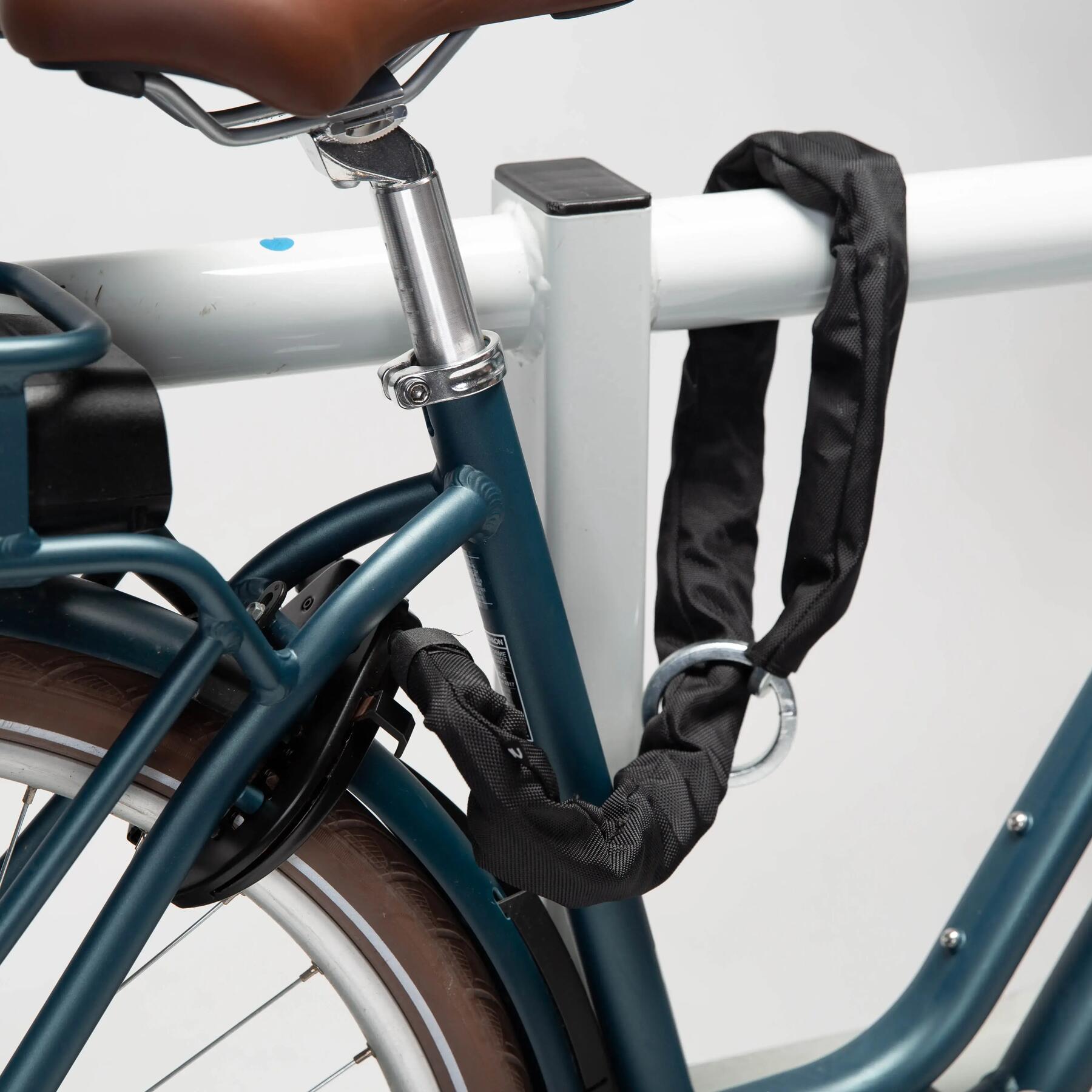
Chain locks are an effective way of securing your bike to a fixed point further away. If the links are thick enough, they also offer a very high level of security. Depending on their length, they can be used to attach two bicycles together to a fixed point.

Because of their high level of security, they are suitable for some everyday cyclists for whom carrying a heavy bike lock is not a problem. Yes, chain locks are heavy. Wrapping it around your torso will arouse the curiosity of some pedestrians and motorists, but more importantly, your vertebrae won't enjoy the ride... Wrapping the chain around your seat tube isn't recommended either, as it could damage your frame's paintwork if its protective sheath deteriorates - which happens very often.

WHAT SHOULD BE DONE? You can store it in a frame bag if you have one. The heavy weight will have fewer undesirable effects if it is located in the centre of the bike, on the frame. You can also slip it into a rear pannier fixed to a luggage rack, where you won't feel the weight too much. Finally, if possible, you can leave it where your bike is often left parked. At home, to secure your bike on your balcony, in your garage, or at your place of work.

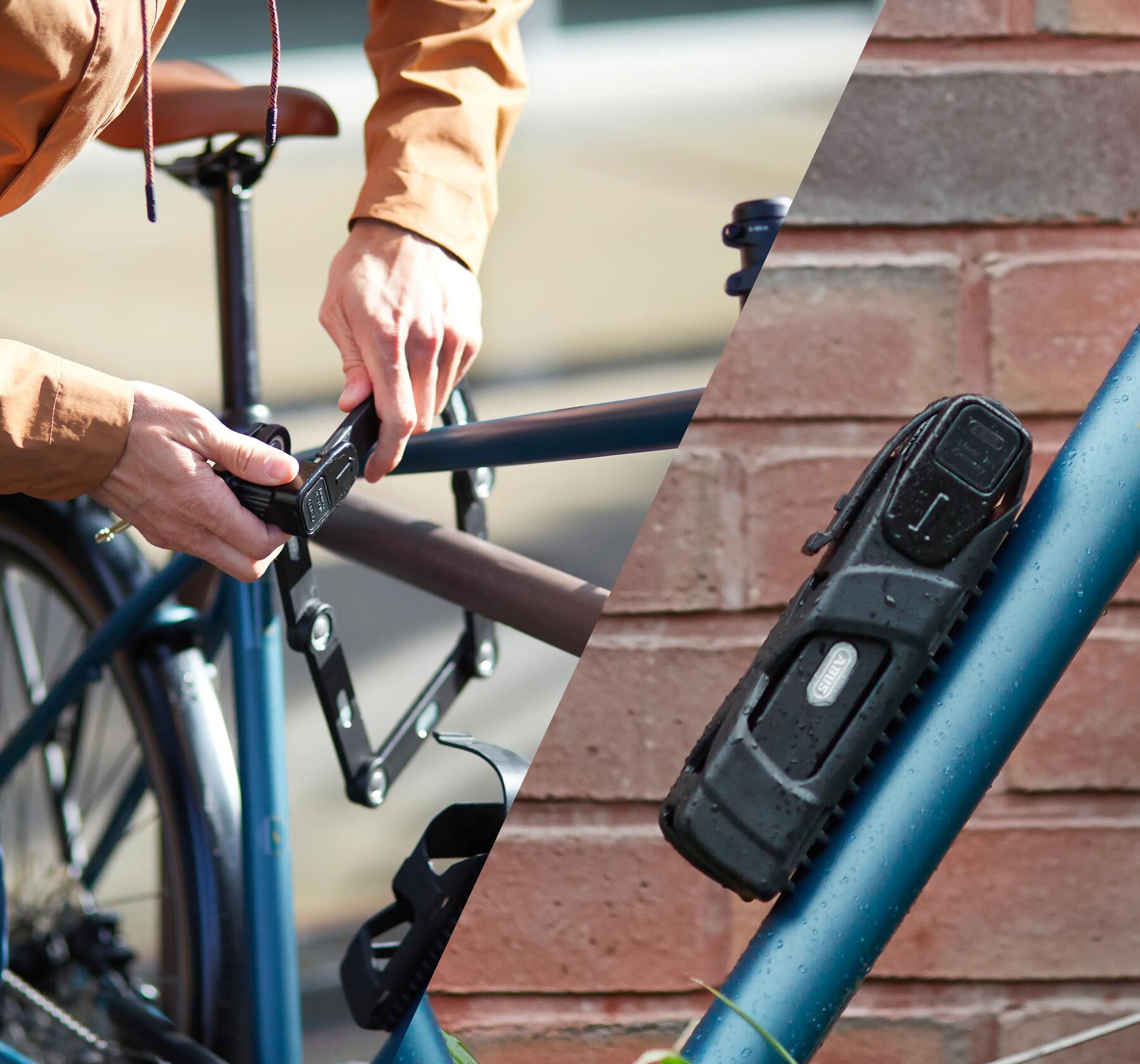
The foldable, compact and easy-to-use segment bike lock

The strong point of this type of bike lock is its compactness. It can be folded and stored in a bracket fixed to the bike frame without taking up all the space on the frame like some D-locks and without rattling on the frame like a badly attached chain.

It is ideal for cyclists for whom the size of the bike lock and its ease of storage are important factors. Folding bike users who regularly take their bikes with them on public transport, to the office or for leisure, like its compactness and easy folding and unfolding.

However, its flattened steel articulated segments are more vulnerable than D-locks and chains, but they are still stronger than a cable. It's best to use this type of bike lock if you don't leave your bike unattended for too long. This type of bike lock looks like a "carpenter's folding rule". If you'd like to include it in your discussions and then give an exclusive demonstration of how a carpenter's folding rule works, don't hesitate!

Cable bike locks, a deterrent but with a low level of security

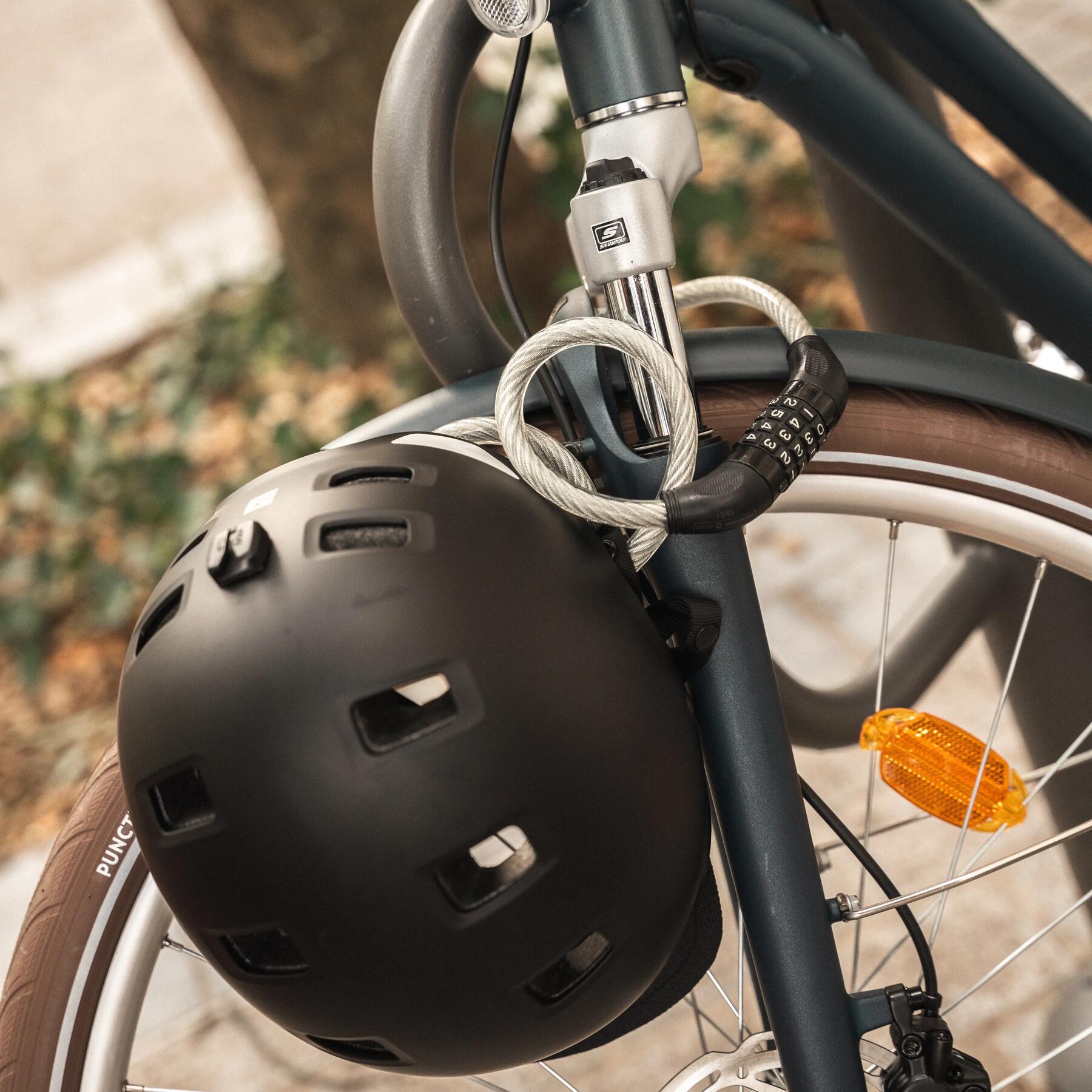
Easy to fit around the frame and a wheel, light but not very resistant to cutting, the cable is useful when you travel with your bike. On a cycle tour, when you stop to raid a bakery at the end of a gruelling climb. Bikepacking, when you leave your bike in the street for a few moments to dash off to the supermarket.

Or, for a more leisurely, everyday use, when you're taking the train with your bike, keeping an eye on it but preferring to 'decorate' it with a deterrent garland, the cable is perfect. You certainly can't measure the power of deterrence, but the cable certainly provides some. But don't leave your bike unattended for long - a pair of cutters will soon remove it.

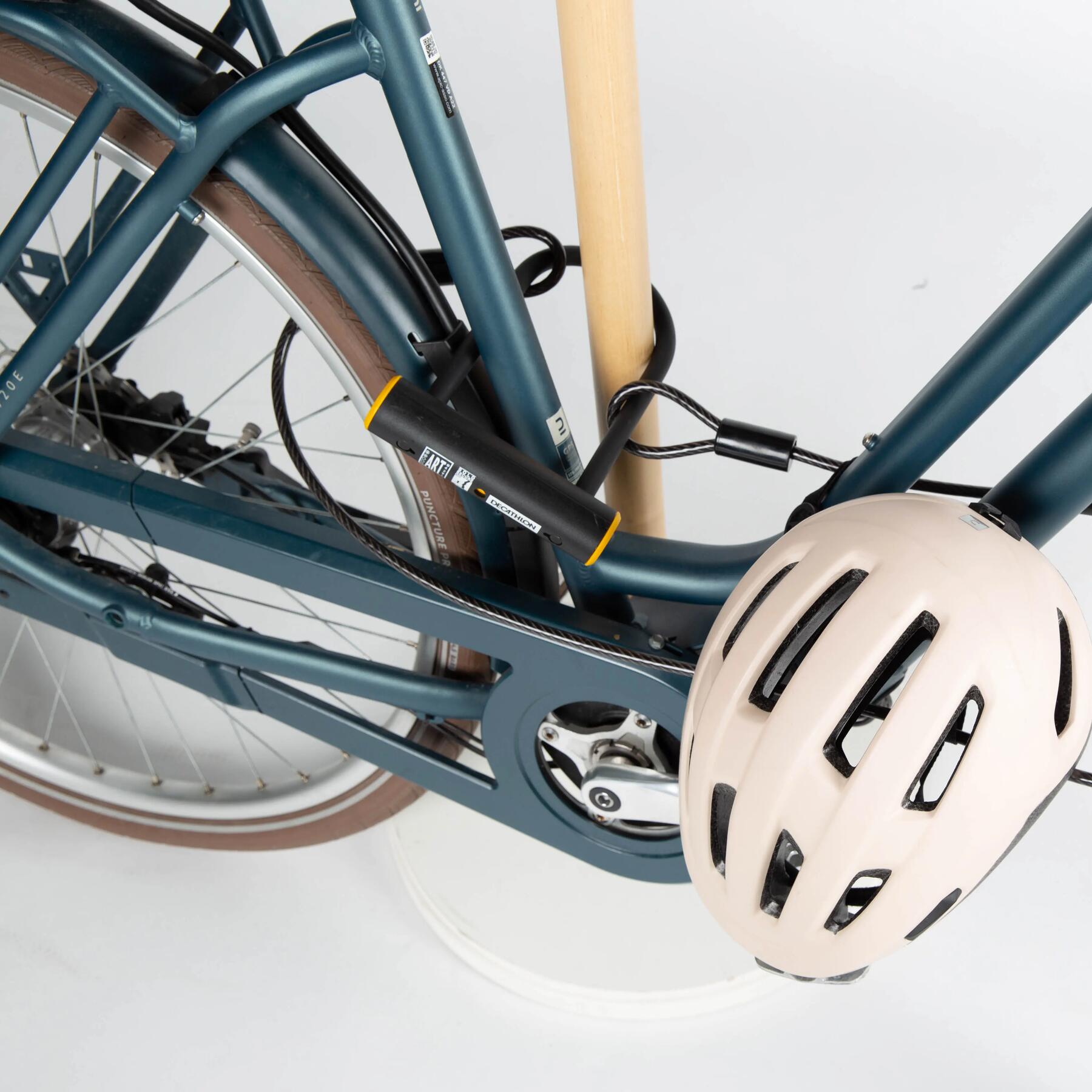
You can also use this type of bike lock for your accessories. Its small diameter means it can fit through the gaps in a bicycle helmet or basket.

The frame bike lock, strong and practical for short stops

The frame bike lock is fixed to the bike's seat stays, is sturdy and secures the bike for short stops. Enjoying a coffee on the terrace while looking at your bike? Buying a baguette on the way home from work? Enjoying the fine weather in a park with a book in your hand and your bike standing sentinel? For all these situations, and an infinite number of others, this "horseshoe" bike lock will block any attempts at theft, because it's strong and can only be disabled by damaging the bike's frame.

For longer stops, add a D-lock or a chain to your bike to avoid any unpleasant surprises.

Bike lock tests, certification, marking and insurance

You've just looked at the wide range of bike locks on the market. To help you choose, we recommend that you consult the certification and approval bodies' search engines, which list and classify bike locks by level of resistance on an international scale.

In France, the FUB (Fédération des usagers de la bicyclette) bike lock committee is responsible for assessing the security level of a wide range of bike locks on sale. Approval is given at two levels: the first, symbolised by a wheel, indicates that the bike lock is resistant to a light tool measuring less than 30 cm. The second level features two wheels and certifies that the bike lock is resistant to larger tools (between 30 and 70 cm).

In the UK, Sold Secure, which was set up in 1992 and is now administered by the Master Locksmiths association representing locksmiths in the UK, issues approvals for a wide range of applications, from bicycles and cars to motorbikes and caravans. The tests are carried out by locksmiths using the most common theft techniques. Sold Secure's classification offers three levels - bronze, silver and gold - which correspond to a degree of resistance to the tools used for theft, with gold offering the highest level of resistance.

In the Netherlands, the ART Foundation has brought together bicycle manufacturers (RAI), consumers (ANWB) and bicycle insurers to develop a quality label for tested bike locks. Five categories are defined, from one to five stars. One star corresponds to minimal security and five stars to bike locks designed to secure a motorbike when parked for long periods. The two-star category represents a very good quality bike lock.

Marking your bike is also an effective tool for deterring thieves, making it harder to resell it or its spare parts. Marking also makes it easier to trace the owner in the event of theft, thanks to the number engraved on the frame, which refers to a national database in which the (protected) personal details of owners are recorded.

Finally, if you want to insure your bike, only by using a bike lock certified by these various bodies will you be reimbursed in the event of theft, breakage or accident. So all you have to do now is make your choice!

REMEMBER:

No lock on the market is indestructible, they can all be broken using a circular saw. It is for that reason that we give no 10/10 scores.

Securing your bike is a must. Combine a certified lock with marking and insurance for peace of mind. Choose wisely and ride worry-free!

WEB_dsk,mob,tab_sadvi_int_TCI_2018_URBAN CYCLING[8402994]city bike htc

Bérengère

City bike communication